Rong Choy

An evolving body of work

WithOurLittleHands

An immersive exhibition exploring agency and consequence, and how even the smallest acts of care compound to shape who we become and the communities we grow together.

Two young children move through and explore the Tend the Garden installation at Bellevue Arts Museum.
Tend the Garden, First presented July 24–26, 2026 at the Bellevue Arts Museum, 2026Photography by Ulara Nishitani

Grow, wander,
discover.

With Our Little Hands is a two-part immersive exhibition by Bellevue artist Rong Choy, launched at the Bellevue Art Fair Weekend 2026 on July 24–26. Through interactive sculpture, collaborative mark-making, responsive technology, original music, scent, light, movement, and sound, the exhibition explores agency, consequence, and how acts of care compound to shape who we become and the communities we grow together.

At its heart are two connected works. Tend the Garden transforms a hand-painted botanical sculpture into a world of discovery, where flowers bloom, mountains move, stars twinkle, clouds bring rain, and hidden surprises reward curiosity, while Grow the Garden invites visitors to draw, create, and leave their marks within a responsive digital landscape.

Every element of the exhibition was designed as part of a single experience—from the hand-painted sculpture and custom-fabricated furniture to the original musical score, scent nebulizers, tactile interactions, and responsive technologies. Rather than presenting individual artworks, With Our Little Hands was conceived as a world to step into, where engineering, storytelling, and play come together to create an environment that responds to its visitors.

A wide gallery view of Tend the Garden and the collaborative making tables prepared for visitors at Bellevue Arts Museum.
Opening the Exhibit, Bellevue Arts Museum, 2026Photography by Ulara Nishitani

A letter
from Rong.

Nothing really prepares you for the full-body, full-mind overhaul that comes with having a child.

One afternoon, after making my daughter cucumbers and carrots for a snack, I found myself hiding under the kitchen counter on the other side to eat a bag of chips. It was a ridiculous scene. There I was—a grown adult, hiding from a two-year-old because I didn't want her eating the very thing I was eating.

The question lingered long after the chips were gone: how do I help my daughter become the person I hope she can be?

Parenthood has a way of holding up a mirror. It asks not only what we want for our children, but whether we are willing to practice those things ourselves.

If I want my daughter to love herself, I must show her what self-love looks like. If I want her to speak her mind, I must be willing to use my own voice. If I want her to grow into a person who is confident, curious, and kind, I cannot simply tell her to become those things. I have to embody them.

Motherhood revealed a gap between what I wanted for my child and what I practiced myself.

Showing up matters. The small things matter. Every goodnight lullaby, every promise kept, every bumped knee and elbow and shin and knuckle kissed better matters.

The weight of that realization changed my relationship to art.

I began thinking about the countless ways children learn—not through instruction, but through experience. Through action. Through repetition. Through seeing what the people around them actually do.

With Our Little Hands is a two-part interactive installation exploring how children come to understand themselves through action.

Part one

Immersive and Interactive Handpainted Kinetic Sculpture

Tend
the Garden.

The first work reimagines Rong’s wooden botanical mindscape sculptures as an immersive landscape for shared discovery. Inspired by the landscapes of the Pacific Northwest, families are invited to wander together—planting flowers across a mountain meadow, making stars twinkle, spinning the sun, sending blossoms dancing on the wind, listening to the rain, and uncovering hidden surprises woven throughout the garden.

Play is often dismissed as something children do before the real work of life begins. Yet play is how children come to understand the world. It is how they test ideas, build confidence, develop empathy, and discover what is possible.

Designed as a shared experience between children and the adults who accompany them, the landscape offers no instructions and no right answers—only invitations: to wonder, to explore, to linger, and to care. Each interaction asks visitors not simply to change the landscape, but to consider how their actions might help it flourish. In tending the garden together, children discover that the world is shaped not only by what we can do, but by how we choose to care for the things entrusted to us.

Together, these works reflect on a simple truth: our lives are shaped by countless small gestures. With our little hands, we comfort. We build. We create. We care.

And in doing so, we become who we are.
Part two

Co-Creation on Canvas with Responsive Digital Media

Grow
the Garden.

The second work invites children to draw, paint, and leave marks within a responsive digital environment on the canvas provided. Long before children understand who they are, they discover that they can affect the world around them.

A cry brings a parent running. A warm handprint on cold glass leaves a trace. A scribble transforms a blank page. Through these small acts, children encounter a profound idea: I can cause change.

At the close of each day, the collaborative canvas is preserved as a finished painting: a lasting record of a community created, quite literally, with our little hands.

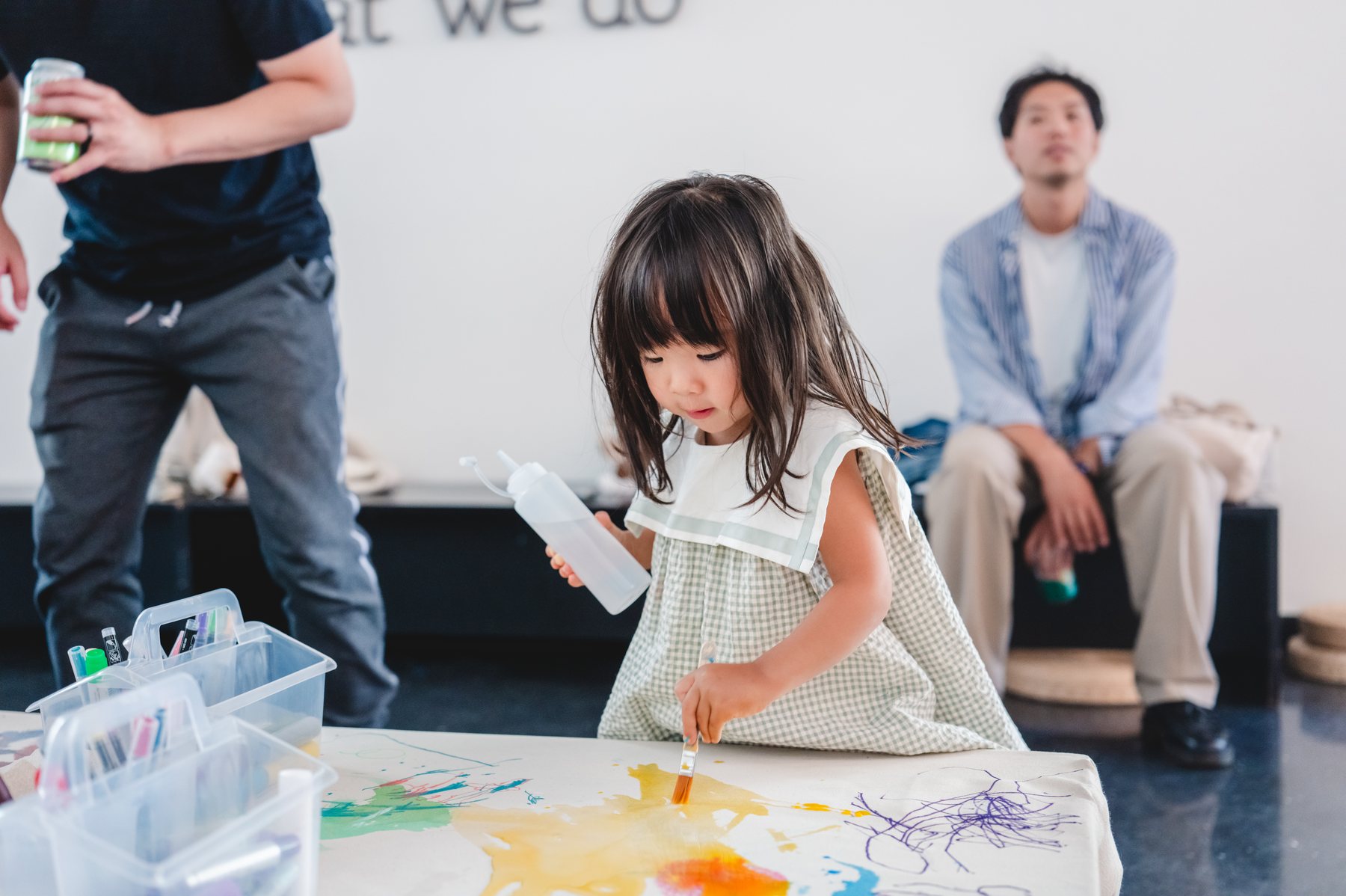
A young child paints a yellow mark on the collaborative canvas during Grow the Garden.
A visitor making her mark on the collaborative canvasPhotography by Ulara Nishitani

Made with
many hands.

With heartfelt gratitude to my husband, Zack Hsi, who greets wild ideas and last-minute scope changes with remarkable grace, and whose technical expertise, unwavering work ethic, and countless hours of problem-solving helped bring this work to life.

To my musical collaborators, Ian Kaneko and Steven Kim, thank you for sharing your extraordinary gifts so generously. Your music does more than accompany this work—it gives it breath, emotion, and wonder, carrying visitors into a space that words and images alone could never reach.

To my friend John Wang, thank you for your time, woodworking skills, generous spirit, and willingness to lend a hand whenever one was needed.

To Milana Nokhrin, sent by the universe at my time of need. Thank you for stepping in without hesitation and embracing every challenge with enthusiasm.

To my mum, Tang Lee Choo, and my mother-in-law, Olive Ong, thank you for preparing the soil. Together you patiently primed the canvases that would soon hold thousands of marks from our community. It felt only right that the very first hands to touch them belonged to family.

Thank you also to Vanessa Bauer, Ethan Goh, and Chris Bentivenga for lending their time and skills during the build and installation.

Finally, I could not have documented this project without photography genius Ulara Nishitani, and her wonderfully patient little model, Haru. Long after the exhibition has ended, the work continues to live through your photographs.

With deep gratitude to Emily Tyler, and the team at Bellevue Arts Museum for championing this project, embracing ambitious ideas, and entrusting me with a space where families can gather, explore, and create together.

The three completed collaborative canvases displayed side by side at Bellevue Arts Museum.
Three collaborative canvasesPhotography by Ulara Nishitani

Roots of
the Garden.